Showers
How Much Does a Tub-to-Shower Conversion Cost in Atlanta?
A conversion price depends on what replaces the tub and what has to change behind it. Define the shower system, waterproofing, glass and plumbing before comparing numbers.
Your conversion price depends on what replaces the tub and what has to change behind it. Angi’s national guide reports an average around $3,000, but that is not an Atlanta-specific average or a quote for a custom tiled shower. Define the base, walls, glass, plumbing, and preparation before comparing prices.
Contents
Angi’s article was updated July 8, 2026. It gives inconsistent lower bounds in different sections, so it is not a clean basis for a precise overall range. You can use its national average as a rough reference — about $3,000 — with clear attribution and clear limits. It is not an Atlanta figure, and it is not a custom-tile-shower figure.
Choose the shower system first
The biggest price lever is what replaces the tub. Three common systems sit at very different points on the cost and flexibility scale.
- Design flexibility
- Limited to manufacturer sizes and finishes.
- Confirm in writing
- Base size, wall finish, and corner vs. centered drain.
- Installation question
- Does the existing tub footprint match an available base?
- Design flexibility
- Walls can be any tile; base is a fixed size.
- Confirm in writing
- Base brand, tile and grout, waterproofing behind tile.
- Installation question
- How is the tile-to-base joint waterproofed?
- Design flexibility
- Fully custom layout, drain location, and finishes.
- Confirm in writing
- Drain type, waterproofing assembly, slope, glass.
- Installation question
- Which waterproofing system is specified, and how is it tested?
| System | Design flexibility | Confirm in writing | Installation question |
|---|---|---|---|
| Prefabricated base + wall system | Limited to manufacturer sizes and finishes. | Base size, wall finish, and corner vs. centered drain. | Does the existing tub footprint match an available base? |
| Prefab base + tiled walls | Walls can be any tile; base is a fixed size. | Base brand, tile and grout, waterproofing behind tile. | How is the tile-to-base joint waterproofed? |
| Custom tiled shower assembly | Fully custom layout, drain location, and finishes. | Drain type, waterproofing assembly, slope, glass. | Which waterproofing system is specified, and how is it tested? |
Avoid promises about lifetime, installation speed, or exact prices that are not tied to a specific product. The right system is the one that fits the space, the budget, and the maintenance you are willing to do.
The six questions that make a quote useful
- Is the new shower staying in the existing footprint, or does the drain move?
- What base and wall system is included — prefab, prefab base with tile, or fully custom?
- What plumbing or drain work is identified, and what is left as “if needed”?
- What glass, door, and hardware are included, and what is an allowance?
- How will exposed damage or unsuitable framing be handled and priced?
- Who is responsible for permits, inspections, and final water testing?
Waterproofing is part of the shower
Tile and grout are not the waterproofing. According to Schluter’s shower guidance, a shower assembly relies on a waterproofing system beneath the tile — at the drain, the joints, and any penetrations — that manages water before it reaches the structure.
Ask the contractor to identify the specified assembly, how joints and penetrations are treated, and the testing procedure that applies to that system and to local requirements. This is not a DIY waterproofing tutorial; it is a scope question. The answer tells you whether the quote includes the part of the shower that keeps the floor dry.
Curbless is a design decision made early
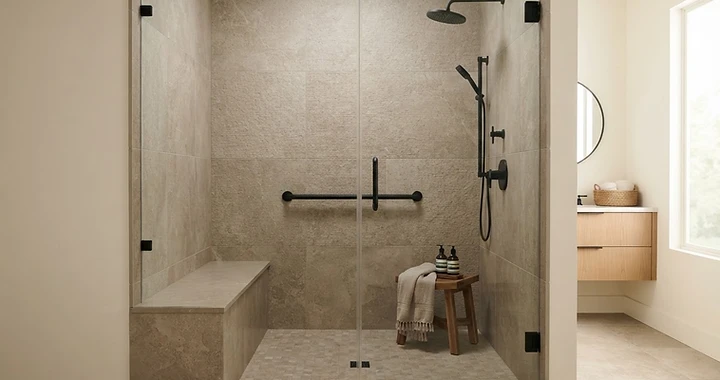
A flush entry is not a standard shower with the curb left off. Per Schluter’s curbless guidance, it depends on floor height, drainage slope, waterproofing, and the floor structure. Whether it is feasible depends on your actual floor construction — a concrete slab and a wood-framed floor are different problems.
Low curb
A raised lip holds water; the shower floor sits above the bathroom floor.
Curbless (flush)
The floor is lowered or built up so the entry is level; drainage and waterproofing are planned into the floor assembly.
Decide early. Reworking the entry later means re-doing waterproofing and tile, not just removing a curb.
Should you remove the only bathtub?
Treat this as a household and future-buyer preference question, not a resale rule. Ask whether anyone in the home uses the tub, and whether another tub remains in the house. Some buyers want a tub; many do not. There is no reliable claim that removing a tub always increases or always decreases resale value — it depends on the market and the rest of the home.
What affects the schedule
A conversion moves through distinct stages: selection, procurement, demolition, preparation, plumbing, waterproofing, finishes, glass, and completion checks. Sequencing, product instructions (especially cure times for waterproofing and thinset), inspections, and custom items all affect how long it takes.
Do not accept a promised one-day conversion or a universal completion time. The realistic schedule depends on the system you choose and what demolition reveals.
Quick answers
Can the existing drain be reused?
It must be assessed. The drain location, size, condition, and the new shower’s base all determine whether the existing drain works or needs to move. That decision can change the price meaningfully.
Does walk-in mean curbless?
No. “Walk-in” usually means you step in without a door swing in the way; the entry can still have a low curb. Curbless means a flush, level entry. They are different construction details.
Does a curbless shower automatically qualify as accessible?
No. A flush entry is one element. The whole layout — clear floor space, controls, grab provisions, door approach — and the user’s needs determine accessibility. See our accessibility and aging-in-place service for the full scope.
Tub-to-shower conversions are one of the projects we do most. If you are weighing one, see our conversion service or request an estimate.
Want a budget based on your bathroom?
Tell us what you want to change and request an estimate. We’ll help you frame the scope before the numbers.
Get My Free EstimateSources
- Angi — How Much Does It Cost to Convert a Tub to a Shower — national guide; ~$3,000 average; article updated July 8, 2026
- Schluter — Shower with Point Drain (waterproofing)
- Schluter — Curbless Shower Systems and Solutions